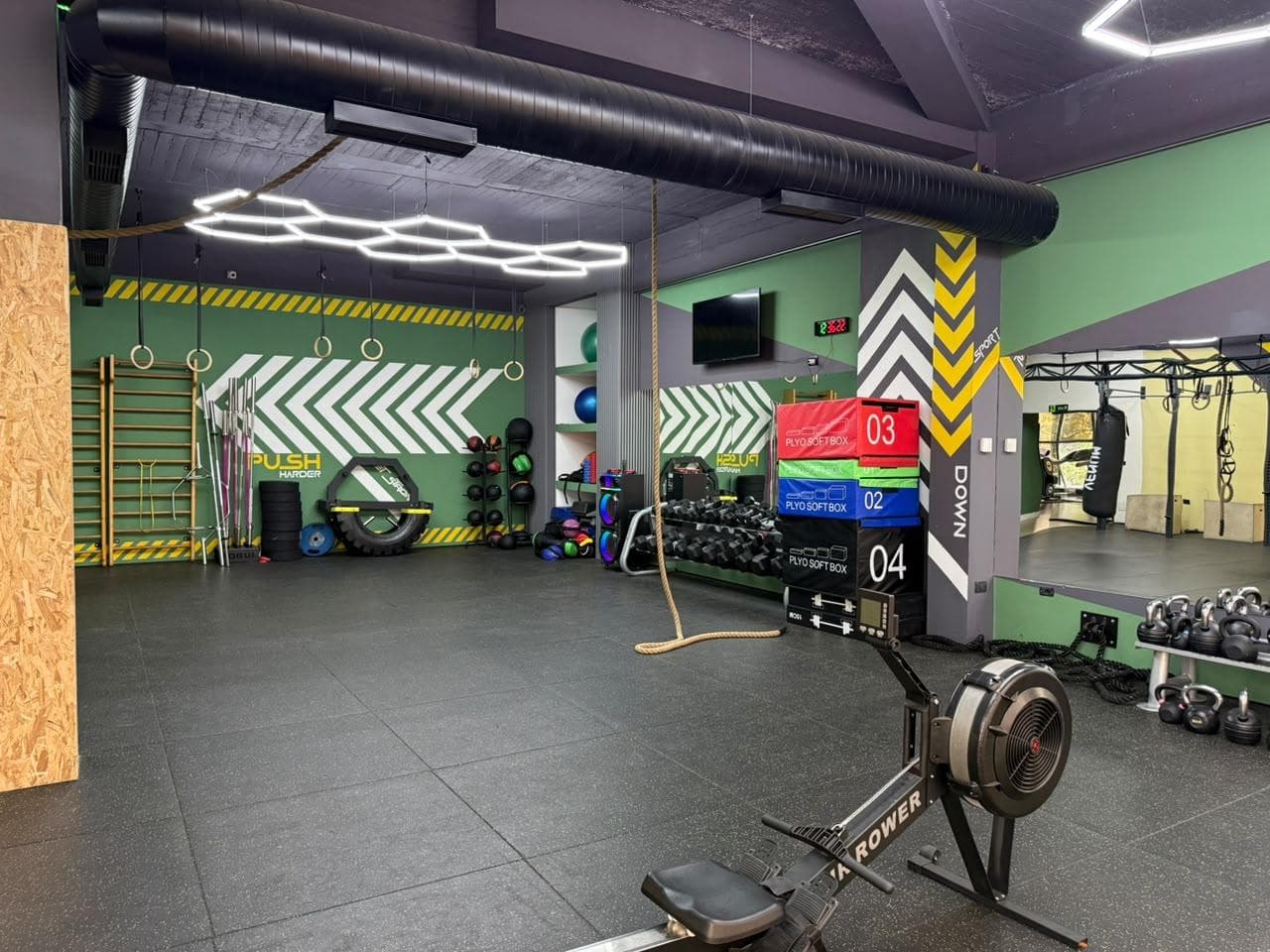
Walk past the kettlebell rack on a Tuesday evening and you will usually find it half empty — not because the kettlebells are unpopular, but because most of them are already in use. Of everything on the functional floor, the kettlebell is the one tool that does the job of a barbell and a rowing machine at the same time, which is why our CrossFit and circuit classes lean on it so heavily.
Why the odd shape matters
A kettlebell's handle sits above its centre of mass, unlike a dumbbell where the weight is balanced around your hand. That offset is what makes a swing, a clean or a snatch feel completely different from a dumbbell equivalent — it forces your hips, not your arms, to do the work of moving the weight. Members who "cannot feel their glutes" in a hip thrust very often feel them immediately in a heavy kettlebell swing.
Strength and conditioning in the same movement
A kettlebell swing at a moderate load and a demanding pace will spike your heart rate the way a sprint does, while still loading the posterior chain the way a deadlift does. That combination is rare. Most equipment asks you to choose between building strength and building conditioning in a given set. Kettlebell work, done properly, gives you a slice of both without changing exercises.
The movements worth learning first
Start with the goblet squat, held at the chest — it teaches an upright torso and a wide, stable base before you add any hip-hinge complexity. Add the two-hand swing once your hinge pattern is sound, then the single-arm swing, which adds an anti-rotation demand through your core. Cleans and snatches come later, after a trainer has checked your swing under fatigue, not before — the technique cost of rushing these two is high.